Authenticity in the age of generative AI: What creators and audiences really want
Backed by our own data from surveys and interviews, this report is a deep dive into how creators and brands are actually using generative tools for video—and how audiences are responding.
Generative AI is reshaping the way video creators and brands approach content—but not without raising important questions about the generative AI impact on creative integrity.
How are creators really using generative AI today?
Where does it help most?
Where does it fall short?
And what do audiences think about AI-generated media?
At Storyblocks, we want to give creators the tools to work smarter without sacrificing creativity or authenticity. That’s why in June 2024, we surveyed 731 Storyblocks members, from individual content creators to editors on in-house teams. We asked how creators integrate generative AI, where they see value, and how they keep their content trustworthy, diverse, and emotionally resonant.
In this report on authenticity in the age of AI, we’ll share what we learned:
How generative AI shows up in video workflows today
The biggest advantages and challenges creators report
How audiences perceive AI-generated content—and why authenticity still leads
Real-world insights from creators and brands on when to use generative AI and when to stick with human-made storytelling.
Our goal: Help creators, marketers, and brands future-proof their content strategies by balancing the best of AI with the irreplaceable value of human creativity.
Because at the end of the day, technology should support great storytelling, not replace it.
How generative AI is used today: trends, adoption, and impact
The most important thing to understand is exactly how creators, businesses, and organizations are using generative AI in their workflows right now.
Because while it’s being incorporated in many tools and software, that doesn’t always mean that it’s been adopted by everyone.
Most creators bring in generative AI with intention and limits. Then, they use it to accelerate early steps and streamline repetitive tasks.
Adoption snapshot: How generative AI is showing early impact
More people are adopting generative AI in video creation but are using it cautiously and incrementally as they evaluate the generative AI impact on their workflows. According to Storyblocks’ June 2024 survey, businesses and individual creators most often use it to support early-stage ideation and post-production tasks, rather than replace human creativity.
Limited integration: 58% of businesses say generative AI powers no more than 25% of their workflows.
Minimal full-scale use: Just 4% of businesses use generative AI for over 75% of their content creation.
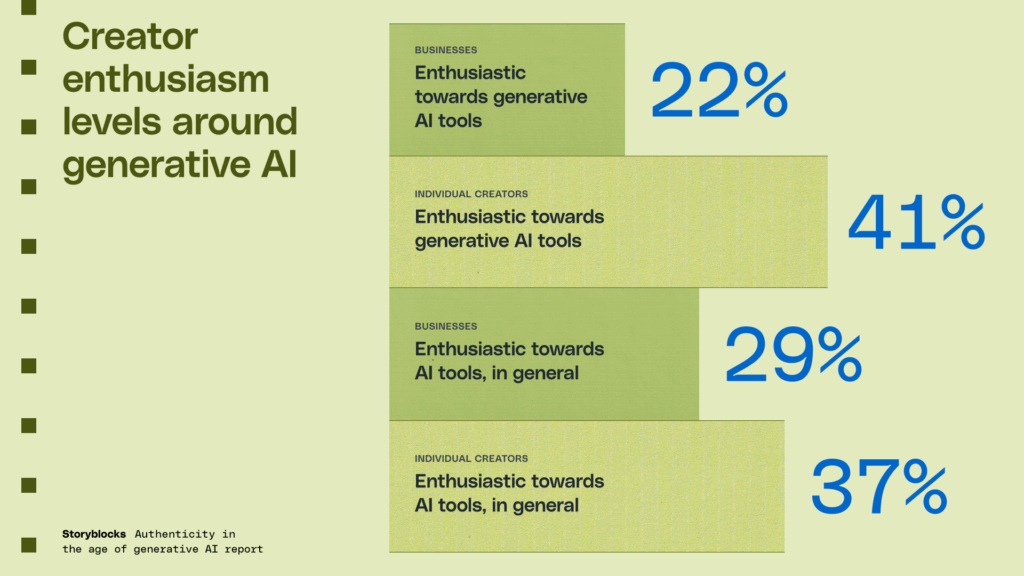
Creator enthusiasm levels around generative AI
As generative AI becomes more accessible, creators across industries are exploring its potential—but not with equal enthusiasm.
37% report feeling enthusiastic about generative AI, compared to just 22% of businesses.
When asked about AI tools more broadly (not just generative AI), 41% of individual creators express enthusiasm, while only 29% of businesses do the same.
This enthusiasm gap likely reflects the different stakes each group faces.
Solo creators and small teams move quickly, often working within narrow timeframes. They embrace tools that speed up workflows and allow for experimentation. With Generative AI, they can efficiently test and modify product videos and social content.
A lot of what I did in my first editing job can now be done automatically. Generative AI is already handling tasks that used to take assistant editors hours. Instead of resisting that shift, I think creators should embrace it and adapt.
Rachel Kisela
Social Media Video Editor
Meanwhile, enterprise creators operate under higher scrutiny. They navigate strict brand governance, complex legal reviews, and content standards tied to trust and regulation. For these teams, adopting generative AI means confronting unresolved questions about copyright, consent, and ethical data sourcing.
Both groups continue to explore AI, but their comfort levels, use cases, and enthusiasm depend heavily on who they serve and the risks they’re willing to take.
Where creators rely on generative AI—and why
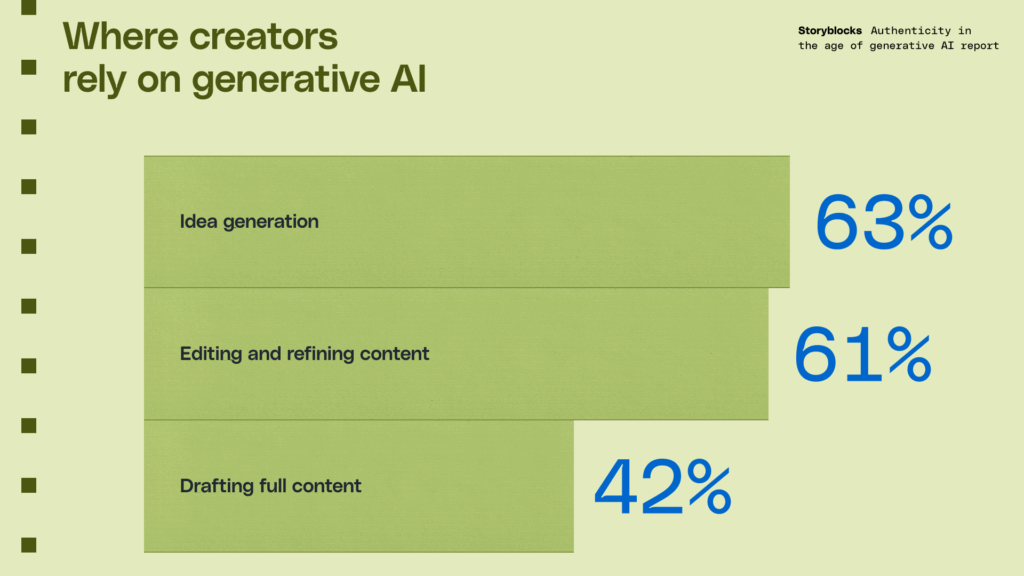
Generative AI use today is more pragmatic than revolutionary. Creators aren’t handing over the creative reins to machines; they’re giving them the grunt work. Here’s how:
Idea generation is where it leads:
63% of businesses use it to brainstorm
Editing and refining content follows closely:
62% of individual creators and 61% of businesses rely on AI to help streamline cuts, transitions, and polish
Drafting full content sees lower adoption:
Only 42% of businesses trust AI to draft
It’s still too risky for most to hand over narrative control
Still, adoption is climbing: 66% of businesses say they’ve used more generative AI in 2024 than in 2023, reflecting the growing benefits of generative AI for businesses. They don’t trust AI implicitly but the time savings outweigh the uncertainties.
Generative AI on the ground: Case studies in use, impact, and resistance
Early adopters: creative teams embracing Generative AI
These teams use generative AI to speed up workflows, explore new visuals, and test creative ideas, with transparency at the core.
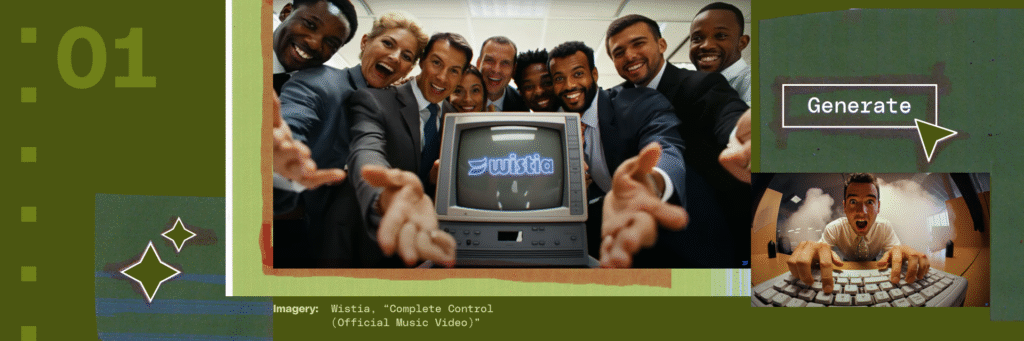
Wistia’s AI brand ads
For their brand campaign, Complete Control, the Wistia team took a bold approach: produce the entire ad using AI. Instead of treating AI as a shortcut, they used it as a creative enabler.
They generated visuals with tools like Midjourney and animated and composited in-house, embracing every oddity AI threw their way. Mismatched hands? Everyone in high heels? They didn’t hide those quirks—they highlighted them.
“We leaned into the weird,” says Sam Balter, head of content at Wistia. “When you’re clearly in on the joke, audiences love it.”
Takeaway: Lean into generative AI where it makes the creative process faster or funnier, but keep your audience in on the joke. When you experiment in public, transparency becomes part of the brand experience.
Superside’s AI-based brand transformation
As part of a brand transformation in January 2025, Superside reintroduced itself as the world’s leading AI-powered creative services company. The team publicly positioned their offerings around a hybrid model—human creativity, accelerated by AI.
Superside now integrates tools like generative image libraries, 3D-illustration engines, and AI-assisted branding workflows. Their goal is to help enterprise teams move faster without sacrificing creative quality.
The company’s new identity reflects a shift in how they deliver creative services. The brand’s reintroduction blog states, “When reimagining our brand, we embraced AI as our primary creative tool. Our team developed a carefully crafted prompt architecture that became the foundation of our new visual identity.
Superside doesn’t just use AI behind the scenes. They help enterprise clients understand how to safely, ethically, and effectively integrate generative AI into their own brand storytelling.
Takeaway: If you’re introducing AI into your creative process, don’t bury the lead. Positioning your brand as AI-forward, when paired with transparency and strong creative standards, boosts client confidence and signals innovation.
Family theater productions
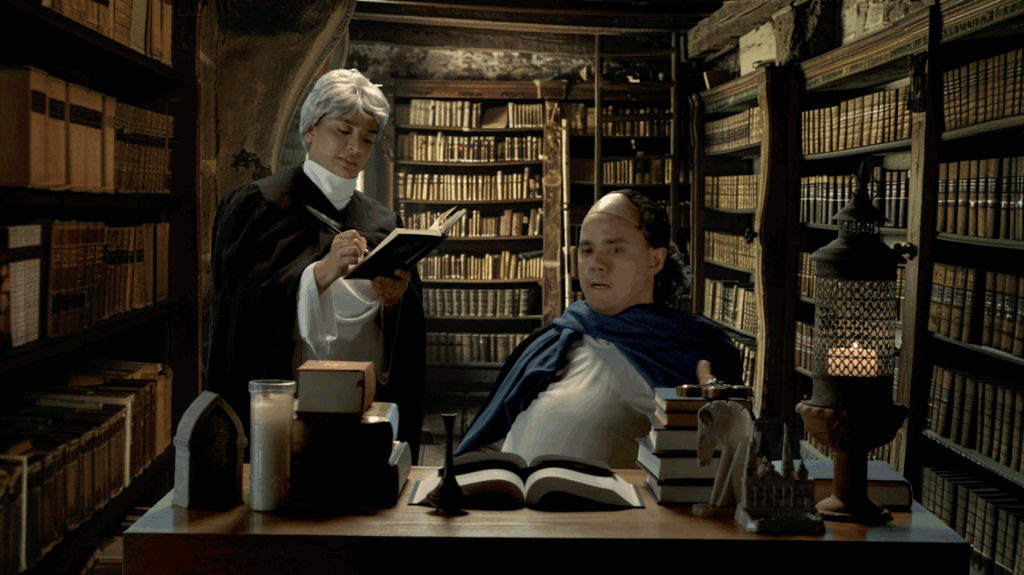
When tasked with visually recreating historically specific scenes such as 1st-century Jerusalem, the team at Family Theater Productions faced a familiar creative wall: the footage they needed simply didn’t exist. Traditional stock libraries came up short, and building sets wasn’t feasible. That’s when producer Don Burt turned to generative AI.
Using these tools, the team crafted hyper-realistic backgrounds that blended seamlessly into their video narratives—creating immersive environments previously out of reach.
A shot for a skit where the Family Theater Productions team used generative AI to create a medieval library as the background.
“We needed imagery that simply doesn’t exist in traditional stock,” Burt explains. “Generative AI helped us recreate it in a way that feels photorealistic and cinematic.”
Takeaway: When traditional stock can’t meet your creative vision, Generative AI can help fill in the gaps—especially for small teams looking to recreate complex, historically accurate environments with minimal resources.
When AI breaks the brand: why some teams opt out entirely
Not all creative teams are jumping on the generative AI bandwagon. For some, the risks to brand trust, artistic identity, or misalignment with AI ethics outweigh the benefits.
Jukin Media refrains from using AI because of ethical concerns
At Jukin Media, editor Evan Watkins has chosen not to incorporate generative tools into his video workflow, pointing to a fundamental clash between automation and artistic integrity.
“If I hand off the process of creation to generative AI,” he says, “I’m removing myself from the process, thus taking part in my own destruction.” For Watkins, the act of creation is inseparable from human connection—and from the years of craft that professionals invest in developing their voice.
Watkins frames the rise of AI as a broader threat to the livelihoods and values of working artists: “AI art devalues human labor in favor of promising larger profit margins for tech billionaires and CEOs.”
He’s not alone in that view. Through informal surveys with fellow creatives, Watkins sees a growing appetite for alternatives that deliver on AI ethics—platforms that “deal with us ethically and simply provide tools for artists.”
Takeaway for marketers: In an industry shaped by creative trust, alienating artists can undermine long-term credibility. As AI adoption rises, so does the expectation for brands to use it responsibly and transparently.
Dove challenges AI with a human-first campaign
Dove’s April 2024 campaign, “The Code,” is a bold stand against the rise of AI-generated beauty standards. While many brands are rushing to embrace generative AI, Dove’s creative team believes there’s a risk of replacing authenticity with algorithmic perfection.
In its short film, “Keeping It Real With The Code,” Dove spotlights real women, pushing back on synthetic images that dominate beauty marketing.
“Dove will never use AI to create or distort women’s images,” the campaign declares, making a clear commitment to authenticity.
“Pledging to never use AI in our communications is just one step. We will not stop until beauty is a source of happiness, not anxiety, for every woman and girl,” says Dove’s CMO Alessandro Manfredi.
For audiences growing more skeptical of AI-generated content, Dove’s stance resonates. It underscores a broader truth: the most powerful stories are those rooted in real emotion, not automated creation.
Takeaway for marketers: In a world where generative AI is everywhere, brands that double down on real human stories stand out. Dove’s campaign reminds us: authenticity builds trust and deepens connection.
Strengths, limitations, and blind spots of generative AI for creators
For creators, the appeal of generative AI is obvious: faster workflows, easier iteration, fewer blockers. But speed doesn’t equal soul.
And the tradeoff that comes with all of the perks of AI doesn’t always balance out as a net positive.
Across the board, we’re hearing the same thing: AI might help you move quicker, but it can’t replace what makes content matter—authenticity, emotional depth, and creative intuition.
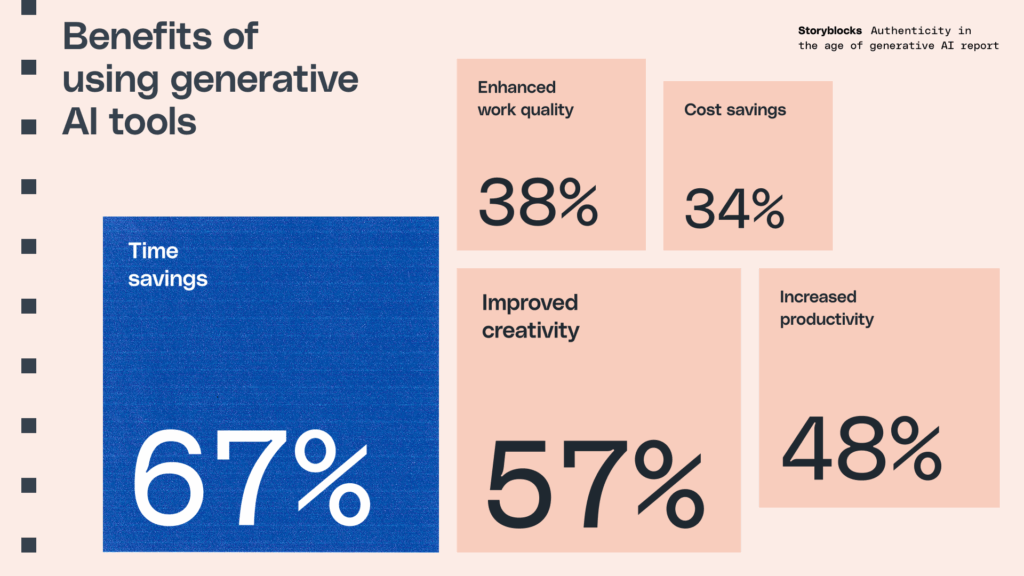
The most common value creators report? Time, one of the clearest benefits of generative AI for businesses.
67% of enterprise teams say generative AI’s biggest benefit is time saved when building stock assets, underscoring the broader value of generative AI in production. It’s helping teams move faster without sacrificing polish.
Scalability
When you’re producing at volume, AI unlocks creative options that just weren’t feasible before. Creators use it to generate multiple versions of a video or localize audio content.
Sam Balter explained that his team uses Wistia’s in-built generative AI tools to dub videos:
We’re using generative AI to translate and dub entire videos—my voice, in another language, synced to my lips. What used to cost dollars per minute and take weeks, now happens almost instantly. That’s huge for scaling reach across markets.
Sam Balter
Head of Content at Wistia
Accessibility
Generative AI expands the creative process beyond designers, which is increasingly seen as a core benefit of generative AI for businesses. Non-visual teammates use AI to generate mockups, create animations, and express creative ideas independently, using tools like RunwayML and Midjourney to level the playing field.
“For our ‘Complete Control’ campaign, we built the whole thing using generative AI:
Suno to create placeholder tracks during concepting
Midjourney to generate high-quality, commercial-friendly images
It lets us explore a new way of producing content without a full production crew. At this point, AI is just woven into the process where it makes sense.” — Sam Balter, Wistia
While generative AI unlocks speed and scale, it still falls short in areas that matter most to human storytelling.
Emotional connection & creativity
Enterprise creators say generative AI is most limited where creativity is needed the most: emotion, intuition, and originality — illustrating some of the most significant generative AI weaknesses.
AI is great for speeding things up. But it can’t capture the emotional nuance that comes from a human creator’s touch. The best use of AI in my mind is as an assistant. Used like that, it can be really powerful.
Kyle Miller
Manager of Video Production at Storyblocks
The challenge is baked into the tools themselves. Generative AI predicts what we already like. But when originality is the goal—something unexpected, boundary-pushing, or deeply human—its outputs often feel safe or generic.
Academic studies back this up: content that replaces human creativity with automation often sees dips in emotional resonance and brand authenticity even in the age of AI.
“Something that is really stand-out and unique isn’t likely to come from AI. AI tools are trained to generate what we already respond well to. It’s not trying to surprise or challenge us. That’s why truly original, emotional storytelling still needs a human at the helm.” — Sam Balter, Wistia
Audience perception
The generative AI impact on perception matters just as much as production.. Storyblocks’ March 2025 consumer research shows that over half of audiences wouldn’t pay for AI-generated content. And younger viewers—especially Gen Z—are the most critical.
For our educational content, trustworthiness is non-negotiable. The public must feel confident in what they see and hear.
Todd Spencer
California DMV
There’s a fine line between assistance and overuse, and this is often where generative AI strengths and limitations become most apparent. When AI becomes too visible, it can undermine the very thing creators are trying to build: trust.
Generative AI legal risks: ethical sourcing, licensing, and copyright
As generative AI moves further into professional workflows, creators are raising smart, necessary questions about how AI-generated content is sourced, licensed, and shared.
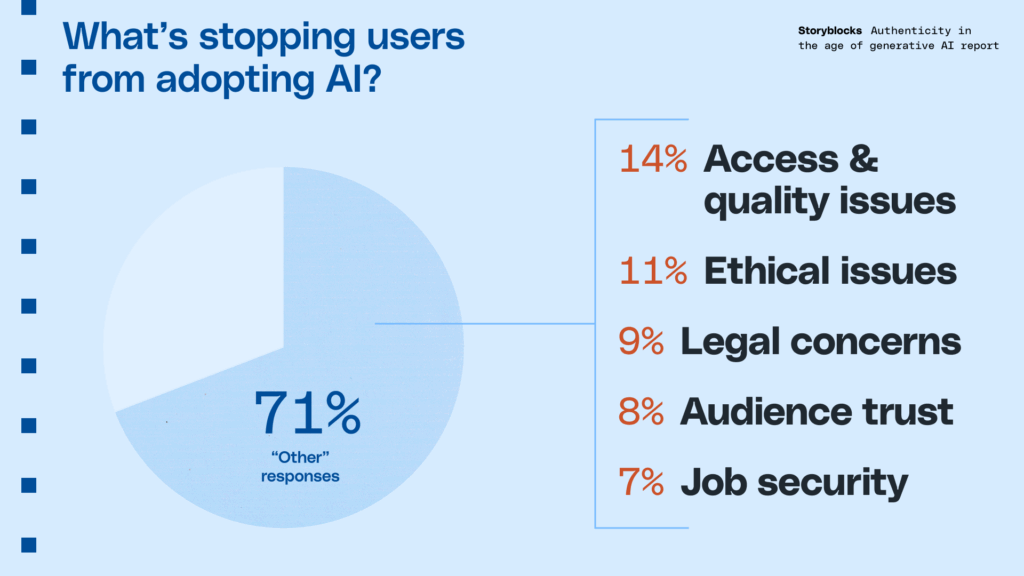
When we asked users what was stopping them from using AI, ethical and legal concerns were among the top contenders in the “other” category.
Keywords such as “ethic” and “licensing” showed up in multiple responses in the sentiment analysis.
Access and quality issues: 14% Complaints included high subscription costs, poor output quality, and too many tools to learn.
Ethical concerns: 11% Comments referenced lack of artist consent, AI plagiarism, and exploitation of creative labor.
Legal concerns: 9% Respondents noted copyright risk, unclear licensing, and client mandates to avoid generative AI.
Audience trust: 8% Creators expressed fear that AI-generated content would erode credibility, particularly in news or education.
Job security: 7% Concerns included AI displacing creative professionals and devaluing craft.
These concerns are real barriers to adoption, particularly for teams working in public-facing industries like education, government, and journalism.
What creators are most concerned about with Generative AI
Data transparency
Many creators said they’ve held back from using generative AI because they can’t confirm where the training data came from. For industries accountable to the public, not knowing whether that data includes copyrighted, biased, or unauthorized material is a dealbreaker.
“I’m hesitant because it’s unclear where it learned this from and if there was artist consent involved.” – April Merl, Tongal
Unclear licensing frameworks
Survey respondents in the news and education sectors said that uncertainty around data licensing was a primary reason they haven’t integrated generative AI into their production pipelines.
“My clients have banned AI-generated images in our work to protect themselves from copyright violations.” – James Lucas, National Institute of Aerospace
Risk to brand trust
Teams know that if AI content slips through without review and turns out to be ethically questionable, the reputational impact of generative AI could be long-lasting.
“We work hard to develop trust with the community, and I do not wish to erode what trust we do have by using images that are not real.” – James Ham, Winnipeg Police Service
Consent and copyright
Replacing or generating content using real people’s voices or likenesses without clear approval presents serious ethical and legal challenges.
“We used generative AI to fix a missing word in a voiceover, but replacing whole lines without the actor’s consent? That crosses an ethical line.” — Todd Spencer, California DMV
More brands are implementing internal checks and safeguards before using any generative AI outputs in public-facing content. What matters isn’t just what AI can do, but whether it aligns with the standards of transparency and responsibility their audiences expect.
At Storyblocks, we believe that creative integrity starts with clarity. Our platform has 100% human-made content with clear licensing and elevates real voices—not murky algorithms.
That’s why Storyblocks continues to invest in our creative community, not replace it. Our exclusive Re: Stock collections feature footage from 10 diverse filmmakers across the U.S. These artists bring emotional depth and unique perspectives to their work, showcasing stories rooted in real experiences—not algorithmic outputs.
This isn’t an anti-AI stance, but rather a pro-art, pro-human and pro-storytelling stance. We celebrate the irreplaceable value of authentic human emotion and the talented artists whose stories inspire that connection.
TJ Leonard
Storyblocks CEO
What Generative AI can’t do alone—and how to make it work with human storytelling
This is where the value of generative AI becomes clearest: it makes teams more productive without replacing creative instincts.
While it’s excellent at streamlining workflows, it still falls short when it comes to depth, emotional nuance, and cultural fluency.
So what’s the right balance to strike to help creatives do what they do best and speed up their workflow?
People can tell when you use too much AI, when what you’re doing lacks authenticity and isn’t human-made. I would use it for vetting ideas, researching, and making human processes more efficient. But I wouldn’t rely on it too much for actual content creation. The magic still comes from human creativity.
Carl Mueller
Senior Vice President and Executive Producer at Dynamo
What Generative AI does best
76% of businesses say time savings is the number one benefit of generative AI in creative workflows — central to the value of generative AI today.. They use these tools to:
Generate storyboards using tools like Runway ML to experiment with framing and pacing early on.
Concept visual themes with AI-generated moodboards before a shoot or animation.
Brainstorm scripts or voiceover drafts to explore tone and structure.
Visualize multiple creative paths, enabling faster decision-making and iteration.
Where Generative AI still struggles
AI content often lacks the consistency and subtlety required for cohesive storytelling.
66% of businesses report reliability and accuracy as top issues when generating stock assets.
Respondents cite:
Inconsistencies in output quality.
Limited ability to replicate visual elements across variations.
Content that feels “fake” or generic—even when technically accurate.
Creators are still in the driver’s seat
Across surveys and interviews, respondents emphasize that AI is best used as a creative partner, not a replacement.
“Focus on connecting with your audience. AI has an averaging effect, which can make your content feel generic and unengaging—even when it looks beautiful. That’s because AI lacks insightful human insight. Experiment with these tools for the grunt work, but not at the cost of creative human input.” —Kirby Ferguson, Filmmaker
But here’s the long game: as generative AI becomes more accessible, the playing field flattens. Everyone gets the same tools, trained on the same data, optimized for the same outcomes. What happens then?
Even if you use AI, your edge comes from the idea—the way you break the pattern, not follow it. That’s only going to matter more as AI becomes more accessible.
Darren Suffolk
Creative Director, Video Services at Superside
That’s the real creative opportunity. AI can help execute—but it can’t invent your voice, challenge convention, or take a risk. As generative tools create the benchmarks, the blockbuster moments will come from human choices: the hesitation in a real voiceover, the imperfect frame that feels lived in, the edit that holds just a little too long because it means something.
Key takeaway: As generative AI accelerates the how, creative differentiation will depend on the why. The more people use the same tools, the more vital it becomes to think against the grain. Let AI handle the repetitive tasks—but keep your originality at the center. That’s where the connection lives.
Practical guidelines for using generative AI ethically and responsibly
These best practices help teams stay transparent, compliant, and in tune with evolving audience expectations.
Transparency: Let your audience in on the process
Being upfront about generative AI use doesn’t make your brand seem less authentic—it makes you more trustworthy. Disclosure builds credibility, especially when you use AI to assist (not replace) human creativity.
Make it standard practice to disclose when you use generative AI in the content creation pipeline. This includes voiceovers, image generation, or even simple script drafts.
Add brief disclaimers in video descriptions or post captions that note AI-assisted elements, especially when those elements could affect the perception of authenticity in the age of AI.
Train teams on when you legally or ethically expect transparency—for example, in educational or public sector content.
Ethical data sourcing: Know what you’re using, and where it came from
Ethical sourcing isn’t just a legal checkbox—it’s a brand value. Use tools that align with your company’s stance on creative rights and fair compensation.
Vet AI vendors the same way you would any creative collaborator. Ask how they train their models, how they handle copyrights, and whether they compensate original artists.
Maintain internal records of the tools and datasets you use, particularly for high-visibility or evergreen campaigns.
Stay within brand guidelines and industry regulations
Generative AI can speed up production, but only if you build in review cycles that catch errors before they become liabilities.
Build internal review checklists for generative AI-assisted content to confirm tone, accuracy, and compliance with advertising standards.
Assign a cross-functional team—including legal, brand, and creative leads—to periodically audit AI-generated outputs.
New EU guidelines (Feb 2025) ban certain AI-enabled practices, including emotion tracking, manipulative dark-pattern interfaces, and covert biometric profiling, setting a high bar for ethical AI usage in media and advertising.
How to choose the authentic sources in the age of generative AI
Generative AI is reshaping video creation but human creativity still defines it. As brands experiment with AI for speed and scale, the need for emotional, culturally resonant, and trustworthy content is only growing. Finding the right balance is a brand imperative.