The truth behind video marketing: Debunking 9 common myths
What’s holding back your videos isn’t effort. It’s bad advice.
If you work in video marketing, these “rules” might sound familiar:
Videos can’t be longer than two minutes
Focus only on one channel
You need a big budget to compete
These sound like best practices that have been passed down from industry pros, influencers, and countless blog posts. But here’s the thing: a lot of that advice is outdated or just plain wrong.
For small teams and independent creators, those myths can feel limiting.
You’re working with tight resources and trying to juggle being a strategist, editor, creative director, and social media manager—all in one. It’s exhausting, and the last thing you need is advice that slows you down.
The good news? You don’t need to treat these common myths as facts. You just need a strategy that aligns with how video works today—one that focuses on creativity, authenticity, and playing to your strengths.
This guide is here to help you do exactly that.
We’ll break down the most common video marketing myths, show why they persist, and—most importantly—help you replace them with smarter, more effective strategies with actionable insights from industry pros and creators who’ve been there.
By the end, you’ll be equipped to push past what’s holding you back. That way, you can build a strategy that works for you—because the most exciting part of video marketing isn’t following the rules. It’s rewriting them.
The video marketing myths and the reasons why they persist
Video marketing myths stick around because they’re convenient shortcuts to complex problems. When marketers and creators face difficult questions—like how long a video should be or how often to post—it’s easier to cling to quick answers than to embrace nuance and the messy, ever-evolving truth.
But video creation doesn’t come with a one-size-fits-all solution.
“I think myths stick because they offer an easy, simple answer to something that’s quite complex,” Darren Suffolk, Creative Director, Video Services at Superside, says. “Take the idea that short-form content always wins because people have short attention spans. It’s been said so often that people just believe it without question. But when you dig deeper, you find examples where long-form content outperforms shorter videos in terms of engagement and conversion.”
Industry influence and technological shifts
Myths are often the result of specific moments in time—industry trends and technological breakthroughs. What worked five years ago might not hold true today, but those strategies live on.
“For a long time, stabilization with tools like gimbals became a trend in the commercial world. You saw big sweeping movements through environments. Then it happened again with first-person view drones,” Darren notes. “The pattern is clear: technology drives the trend. The same goes for platforms. UGC content thrived as phone cameras got better. The trend is a direct result of what technology makes possible.”
The problem with these trends? They can easily become the standard narrative for how to succeed, even after the moment has passed.
Why you need to push past and go beyond video myths
The best marketers recognize that video is always evolving, and the biggest wins come from staying curious, questioning norms, and being willing to go against the grain.
The good news? Once you spot these myths, you can build a smarter, more flexible strategy that fits the modern video landscape.
Myth-busting the 9 most common video marketing myths
The rules you’ve been told about video marketing deserve a second look. Let’s start with the biggest myths.
Myth #1: Good video is expensive to produce
“If you’re not spending tens of thousands on video, don’t even bother.” That’s the kind of advice that keeps good marketers stuck—watching competitors win with content they think they can’t afford. And like most myths, this one comes wrapped in just enough truth to feel real.
A decade ago, sure, producing a single 30-second spot meant shelling out for expensive cameras, professional lighting, and a crew big enough to stage a small concert. But in 2026? The game’s different.
No, good video doesn’t have to be expensive to produce – that’s a myth. In reality, creatingquality content today is about how smart you are with what you have.
“The biggest myth I hear is that video is expensive. That used to be true. Not anymore. Our strategy at Storyblocks is to start small—testing concepts with still images or text-based videos—and scale what works. It’s low cost, low risk, and gives us the data to invest where it matters.” — Kyle Miller, Video Production Manager at Storyblocks
What makes this approach powerful isn’t just the technology, though it helps that you’ve got your phone’s 4K camera in your pocket. You don’t need a $50,000 budget to test an idea. You just need the guts to experiment, learn, and grow.
“Everyone has a 4K camera now. That doesn’t mean they’ll get good footage,” Darren says. “Talent is the difference. The good news? That talent is more affordable and accessible than ever.”
In other words, your phone is ready, but you’ve got to be too. And nobody proves that better than creator, consultant, and speaker Jade Beason, who built her brand (298K subscribers on YouTube) on a budget that most people would spend on coffee in a week:
“For the first nine months, I shot everything on my phone. My mic? £10 from Amazon. My first proper camera? I didn’t buy one until years later. The secret is knowing how to make what you have work for you.”
Carl Mueller, Senior Vice President and Executive Producer at Dynamo, agrees: “The most dangerous myth is believing you need expensive gear to succeed. I’ve seen creators shoot with nothing but a smartphone and a window for lighting and absolutely crush it. If you understand basic storytelling and composition, you’re set.”
The takeaway?
Budget doesn’t equal success. Creativity does. The myth that good video is expensive to produce isn’t just wrong – it’s costly, keeping your business stuck on the sidelines. Here’s what to do instead:
Start with what you have: Successful creators don’t always wait until they can afford expensive gear; they make the most of what they have, learn as they go, and upgrade when it makes sense.
Focus on creating and delivering value: Focus on your message. Build as you go. And remember, in a world flooded with content, creativity beats budget every time.
Myth #2: AI will replace humans in video creation
Video teams are signing up for video tools by the dozen, but adoption is more measured than the hype suggests. Most teams are experimenting—not fully committing.
58% of businesses use generative AI in 25% or less of their workflows
Only 4% rely on it for more than 75% of content creation
63% use AI mainly for idea generation, and 61% for editing and refinement, not full production
This measured adoption reflects a real tension. The tools increase output, but they also introduce new risks around quality, trust, and brand consistency. In fact, 66% of businesses report reliability and accuracy as top issues when generating assets, especially when consistency across variations matters.
AI is changing workflows but not replacing judgment
For most teams, AI’s biggest impact is operational. It accelerates scripting, editing, production cleanup, and iteration. It allows teams to move faster and test more ideas.
Ron Dawson, Content Marketing Lead at Replit, emphasizes that the core question hasn’t changed:
“When it comes to AI and video, go back to what’s the purpose of the video. Yes, it can reduce the number of people who have to be involved, but there’s still a lot of work that goes into making AI video and a lot of creativity. At the end of the day, is it accomplishing what you’re trying to achieve?”
This shift forces teams to rethink their role. Instead of spending time on manual production work, creators focus more on narrative direction, audience relevance, and strategic intent.
How teams are actually using AI today
Today, AI is deeply embedded in video workflows, but in focused, practical ways.
Kirsti Lang, Senior Content Creator at Buffer, describes how AI supports their process:
“I use Claude to help draft scripts faster, which significantly speeds up that part of the process. I also use AI features baked into tools like CapCut—auto-editing to remove pauses and dead space, background removal, transcript generation. Those smaller support features are really helpful.”
But she also draws a clear boundary around where AI stops.
We don’t use generative AI to create videos. We experimented once with an AI-generated launch video, and while it was interesting, it’s not something we do regularly. Our warmth and humanness are core to Buffer’s appeal, so we don’t use AI talking heads or AI-generated presenters. AI is a support tool for us, not the creator.
Kristi Lang
Senior Content Creator at Buffer
Speed is valuable, but authenticity still wins
Even when AI is used more heavily to speed up production, the expectation is that it must support the audience experience.
Ron explains the tradeoff clearly:
“If you’re going to use AI for video, it needs to look really, really good because it can take people out of the experience if they can tell it’s AI. Even if you have a good reason for using it, if it breaks immersion, you need to ask if it’s the best choice.”
In practice, this means teams evaluate AI not just for speed, but for how it affects audience trust and perception.
This is becoming the emerging operating model for modern video teams:
AI handles execution.
Humans shape meaning.
Creativity shifts upstream.
The value of creators increasingly lies in interpretation, perspective, and storytelling.
The takeaway?
The real risk isn’t that AI replaces creators. It’s that teams stop making intentional choices.
AI lowers the barrier to production. It makes it easier to create more, faster. But volume without direction doesn’t build trust, and automation without clarity doesn’t build strategy.
Before adopting any AI tool, ask:
Does this strengthen the purpose of the video?
Does it improve the audience experience?
Does it protect the distinctiveness of our brand?
Because the teams that win aren’t the ones that resist change—they’re the ones that stay disciplined about why they’re creating in the first place.
Myth #3: Videos should be less than 2 minutes long
If you’ve ever hesitated to create longer videos because “people won’t watch them,” you’re not alone. The under-two-minute rule became an industry standard years ago, driven by outdated attention-span studies and early digital platform constraints. But here’s the thing: that rule is holding you back.
The reality? Platforms like YouTube and TikTok are actively encouraging longer content. In 2024, on YouTube, uploads of videos under 30 seconds grew by only 5%, yet videos over 30 seconds surged by 39%.
Your viewers will absolutely commit to longer videos if the content is worth their time. What matters is relevance, pacing, and keeping the audience engaged.
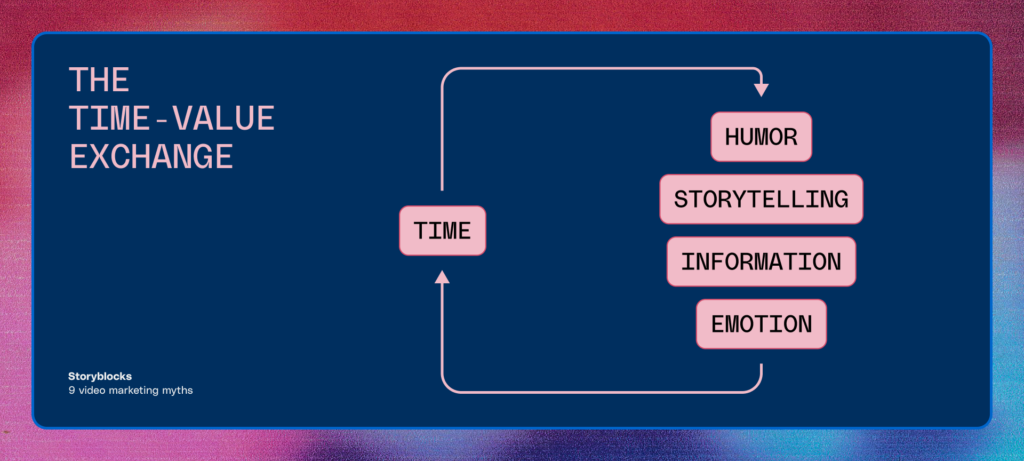
“People stream long content on their phones every day, even if it’s not that good,” Darren says. “It’s not about length—it’s about value. If your video offers real information, humor, or emotion, people will stick around for 10 minutes or more.”
Jade highlights the bigger trend: “The algorithms prioritize retention, not length. If you can keep people engaged, platforms will reward your video—whether it’s 2 minutes or 20. Long-form content is back, especially on YouTube, where people are watching videos on their TVs, not just their phones.”
Short and long formats serve different strategic roles:
Short-form attracts attention.
Long-form builds trust and depth.
“The idea that long-form content is dead is just wrong,” says Carl. “Platforms want longer videos because retention matters. If you create a 20-minute video that keeps people engaged, you win. Long videos aren’t out—they just need to deliver.”
When to go long
Long-form content works when you have something to say that goes beyond a surface-level soundbite. Tutorials, behind-the-scenes looks, thought leadership, and in-depth storytelling all thrive in a longer format.
If your story needs time to breathe, give it that time. But always keep pacing, structure, and value delivery in mind.
Kyle Weber, Creative Marketing Lead at Motion, offers a word of caution: “You’d be crazy to make something long just for the sake of it. Take as much time as you need—no more, no less. Time is the one resource your audience can’t get back. Don’t waste it.”
The takeaway?
Forget the rule that videos should all be less than two minutes long – it’s a myth. Instead, focus on the purpose of your content.
Let your story dictate the length: Don’t cut a video short just to fit an arbitrary length—if your story is engaging, people will watch. The key is pacing: edit well, document plenty of footage, and focus on creating a connection with your audience. “Do what your story calls for,” says Kirsten van Rooyen, Director of Marketing Strategy at Superside.
Use short-form content strategically: You can use bite-sized content to spark curiosity and lead your audience to explore more. “We see a lot of cases where short-form content is the catalyst to drive people to long-form content. It’s almost like micro advertising,” says Kirsten.
Myth #4: Online videos are consumed only by younger audiences
For years, online video has been viewed as a playground for younger generations—Gen Z dancing on TikTok or teens bingeing YouTube channels. While it’s true that younger audiences were early adopters of short-form video, the idea that online video is exclusively for them is flat-out wrong.
Today, video is a universal medium that transcends age groups, lifestyles, and interests.
As Darren points out, the evolution of technology has made online video accessible to everyone: “My entire family watches video content online, including my 65-year-old dad. The tech has become accessible to almost everyone—phones with great screens and streaming capabilities aren’t just for early adopters anymore. Video consumption has become universal.”
The growth of video across generations
Video consumption continues to expand across every age group, but what’s changed is where they watch and how they discover content.
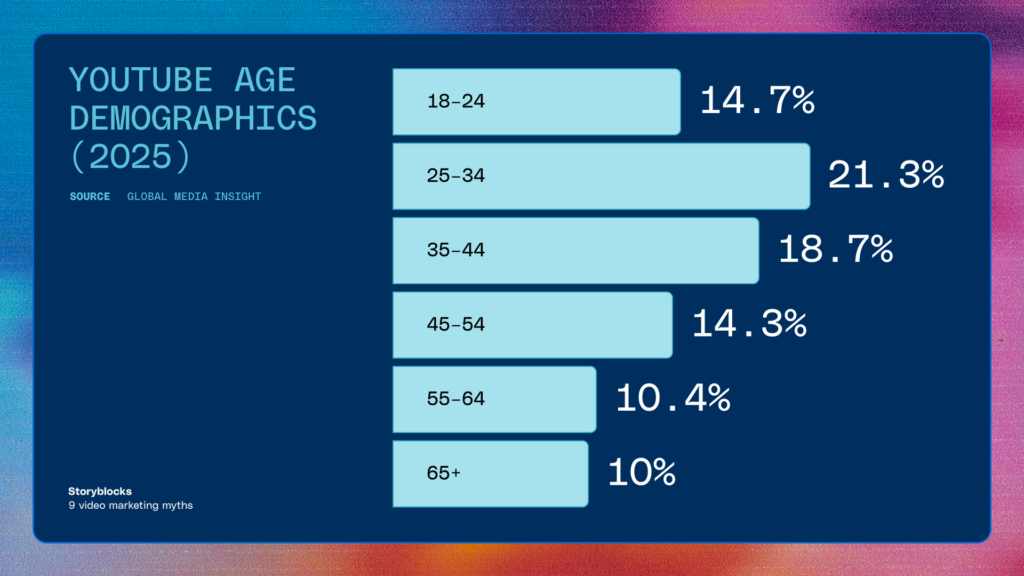
According to DataReportal’s Digital 2025 Global Overview Report, 9 out of every 10 people (ages 16–65) watch videos online each week, with usage rising across all major age segments. What differs between audiences is platform behavior, expectations, and intent.
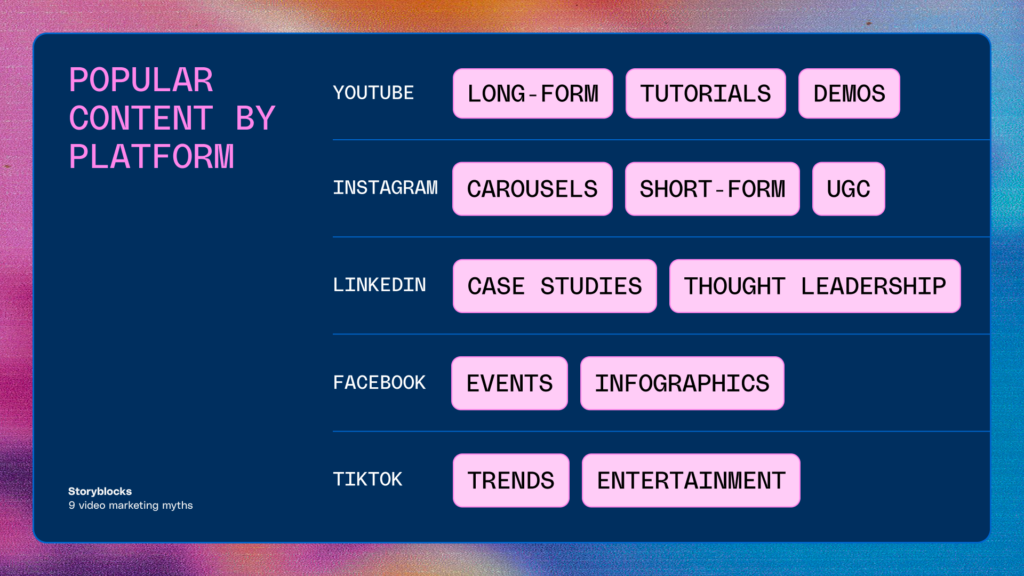
Different audiences show up in different places, and they expect different things from video on each platform. YouTube, LinkedIn, and social platforms all have very different viewing behaviors. The goal should be to understand where your audience already spends time and what they’re trying to get from the content there.
Kyle Miller
Video Production Manager at Storyblocks
Younger audiences continue to drive short-form trends, but older demographics are increasing their engagement across YouTube, Facebook, and professional platforms like LinkedIn. At the same time, video discovery is no longer limited to social feeds. Search engines, AI overviews, and embedded video results are reshaping how people find and consume content.
Kirsti describes how this shift changed their expectations:
“I assumed YouTube would primarily be a brand awareness play rather than a direct sign-up driver, and that’s held true. What surprised me was how powerful video became for supporting our blog content. Our videos are being surfaced in AI overviews, cited by LLMs, and even embedding our YouTube videos in posts can improve search visibility.”
For marketing teams, the implication is clear: audience strategy should focus less on demographics alone and more on platform context, discovery behavior, and viewing intent. Understanding where your audience engages—and why they engage there—helps you create video that feels relevant and worth their time.
The takeaway?
Video is for everyone. Whether it’s Gen Alpha swiping through TikTok or a 60-year-old executive watching a how-to video on LinkedIn, it’s the content’s relevance that matters—not the viewer’s age.
Don’t assume—analyze:Meet your audiences where they are. Use platform insights and data to understand the real makeup of your audience and experiment with content styles.
Adapt your content for each platform: If you’re posting on multiple platforms, edit and tailor your content every time you publish ensuring it aligns with how users engage on that platform.
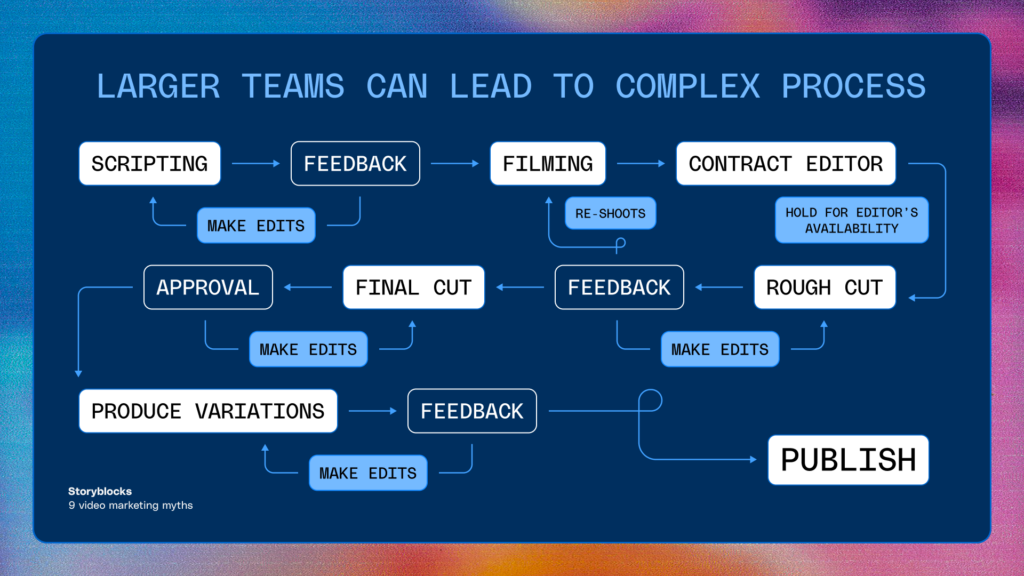
Myth #5: You need a big team to create high-quality videos
Today, small, agile teams are running circles around traditional setups, delivering high-impact content with fewer people, less complexity, and more creativity.
“Technology and improvements in filmmaking practices mean that very high-quality results can be achieved by small teams,” says Darren. “You don’t need a large crew anymore to get professional-level results. With the right skills and tools, a modest group can create exceptional content.”
The shift is about agility more than technology. Small teams can move faster, adapt quicker, and experiment more freely. They’re not bogged down by the multiple layers of approval and bloated production schedules.
“Small teams can be incredibly efficient and produce amazing content with the right approach,” says Kyle Weber. “The key is having people who can wear multiple hats and adapt quickly. Sometimes, more people just slow things down and complicate the process.”
Rachel Kisela, Social Media Video Editor, has seen it play out over and over: “The belief that you need a large team to create high-performing content is outdated. I’ve seen creators achieve incredible success with very small teams. What people care about is authenticity—the stories being told, not how many people are behind the camera.”
For today’s most successful creators, versatility is a superpower. One person might plan the shoot, capture the footage, edit the video, and run distribution.
Lead with authentic stories: “People want narrative, people want storytelling,” says Jade. And good stories don’t necessarily need a big team. They can work with a single person’s unique perspective.
Work with skilled people: Expensive video production equipment won’t make up for a lack of skill, but skilled creators can make even basic tools shine. “Hire smart people, create, give them creative freedom, and check in on them,” says Carl.
Stay agile: As a small team you have momentum. Without layers of approvals and bloated production schedules, you can move fast, test ideas, and double down on what works.
Myth #6: Stock footage is always cheesy and generic
Stock footage used to mean poorly lit scenes, awkward high-fives, and overly polished slow-motion shots. It felt inauthentic, disconnected, and corporate. But stock footage today is a completely different story.
“Libraries now offer cohesive, high-quality content shot in the same location with the same actors. You can build entire sequences from stock that feel polished and purposeful,” says Darren.
Creators are now blending stock seamlessly into their projects, saving time and money while keeping quality intact. In fact, most viewers can’t even tell what’s stock and what’s custom.
Jade knows how powerful stock footage can be: “I use stock footage all the time. It’s only cheesy if you’re picking generic clips. When you’re watching a vlog with a drone shot of Manhattan and wondering how they got that footage—they didn’t. It’s stock, and you’d never know.”
“The key is blending stock footage with other assets—adding sound effects, color-correcting it, or combining multiple clips,” says Rachel. “Small adjustments can completely change how it feels.”
Stock footage quality has skyrocketed in recent years. “The bar is higher now,” Kyle Miller explains. “If stock providers upload generic footage, it doesn’t get downloaded because better options are available. It’s like collaborating with artists worldwide. The quality is authentic, personal, and better than ever.”
Used intentionally, stock doesn’t look like a compromise; it elevates your work and saves hours of production time.
The takeaway?
Plan around stock footage, not after it. Before you shoot, identify the shots you can’t capture yourself and source stock footage first.
Use stock strategically: “The key to making stock footage feel less generic is how you use it,” says Rachel. “Combine it with other assets, add overlays, tweak the color, or use sound design to give it a unique feel. With the right adjustments, stock can blend seamlessly into your project.”
Think beyond B-roll: Stock footage isn’t just filler—it can be the foundation of a story. Use it to establish locations, create smooth transitions, or even supplement missing shots in interviews and narratives.
Myth #7: You should focus only on one channel for video
Putting all your energy into a single channel may feel like a smart play—especially when you’re building traction fast. But relying too heavily on one platform? Might not be the best bet for growth.
Rachel has seen it happen too many times: “Platforms change fast. If you rely too heavily on one and the algorithm shifts, your reach can disappear overnight. It’s better to diversify—on platforms that make sense for your brand.”
Ron explains that channel strategy is about control:
“YouTube may be an incredible channel for discovery, but it’s still a rented platform. If someone watches your video there, they’re immediately shown other videos—often from competitors. You have to think carefully about where you want your audience to go next and what experience you want them to have.”
This shifts the conversation from simply posting everywhere to understanding the role each platform plays—discovery, engagement, or conversion.
Why multi-channel matters
A multi-channel strategy is about understanding which platforms align with your audience, your content, and your goals—and using them in a way that amplifies your reach.
“The right channel depends on what you’re trying to achieve. Sometimes a specific approach on one channel is best. Other times, a multi-channel strategy works. A good strategy maximizes reach by choosing the right platform combination—not by posting everywhere,” says Darren.
The takeaway?
Single-channel focus is a good starting point, but it’s not a sustainable long-term strategy. The key is to start where you’re most comfortable and expand strategically. Here’s how:
Diversify your platforms: That way, if one changes, you’ve already built a presence elsewhere, giving you a safety net. The key is to start where you’re most comfortable and expand strategically.
Repurpose your content: If you’re already doing well on Instagram, try repurposing that content for TikTok. If you’ve built a library of long-form YouTube videos, break them into shorter clips for LinkedIn or Facebook.
Go where your audience is: Like we mentioned with myth #3 (online videos are only consumed by younger audiences), use insights to understand your audience and what platforms they’re most likely to be on. Then prioritize those platforms.
Myth #8: Your video content should always be perfect
It’s easy to believe that only perfect videos get noticed. After all, social media is filled with highly polished content. This myth persists because perfectionism is often mistaken for professionalism.
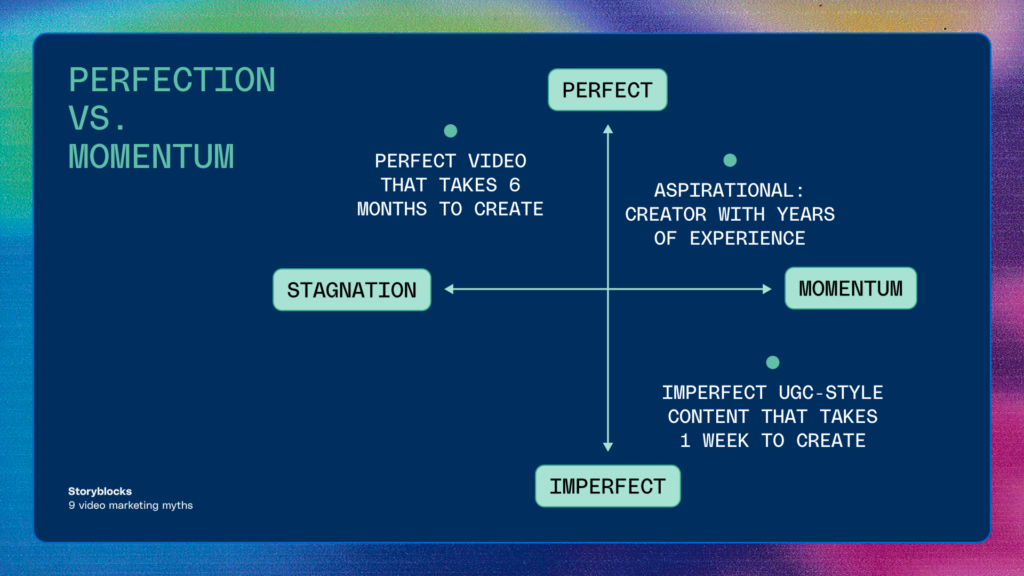
But forget perfect. Perfect is the enemy of progress. In content creation, speed, consistency, and adaptability beat polish every time. Chasing flawless videos is an easy way to burn out fast, and it won’t guarantee better results.
The obsession with perfection often comes at the expense of momentum. Creators get stuck tweaking and refining, waiting for “perfect,” while those willing to publish, learn, and improve keep building an audience.
Kyle Miller puts it bluntly: “We used to spend way too much time refining every little detail. Then we realized that great is better than perfect. By getting content out there fast, we could learn what worked and iterate. In today’s world, speed and adaptability matter more than perfection.”
Quality without consistency is a dead-end. Creating a sustainable rhythm beats pumping out one perfect video every six months.
Naomi Liddell, Content Lead at Doist describes how their team reframed video production early on:
“We treated video as an experiment from the start and shared what we were learning publicly. That removed the pressure to be perfect and helped us improve much faster because the audience was learning with us.”
Treating content as ongoing experimentation helps teams move faster, reduce creative pressure, and build stronger audience trust.
Perfectionism can also impede creativity.
“Perfect doesn’t exist—it’s subjective. Some of our best-performing content was rough but real. The connection with the audience mattered far more than the production value,” says Kirsten.
The takeaway?
Get your content out there. Learn fast. Improve.
Focus on learning: “When you’re starting, focus on quantity—just create a lot,” says Jade. “That’s how you’ll improve quickly. Once you’ve got the basics down, you can shift to focusing on quality. But trying to be perfect from the start will slow you down and hurt your growth.”
Iterate quickly: “You have to be patient and steadfast, and iterate. Because things take time. You have to post, try new things, see what the audience likes, and then adjust moving forward,” says Carl.
Find your unique creative voice: “Choose a niche you genuinely care about, not just one that’s profitable. When challenges come—because they will—passion is what keeps you going and helps you build something sustainable,” says Jade.
Myth #9: Viral success can be achieved with a single, well-crafted video
The idea that a single, perfectly crafted video can launch you into viral stardom is one of the most persistent myths in all forms of content creation. But virality rarely happens in isolation.
“The fallacy is that you can create one piece of content, and it just goes viral. Viral hits are almost always the result of a lot of groundwork—identifying a tone of voice, building an audience, and testing different ideas. Eventually, the conditions are right for a piece of content to explode,” says Darren.
Those seemingly “overnight” successes are more like the final domino in a long chain of hard work.
Any overnight success—whether that’s like an influencer that suddenly exploded, or a brand that’s seen a massive amount of success out of nowhere with video—has put in effort over an extended period of time to find that success. But people just see the success.
Darren Suffolk
Creative Director of Video Services at Superside
The obsession with virality can also be misleading. Viral success may look appealing, but it’s not always sustainable. Creators who thrive beyond their viral moment are the ones who already have a system in place to keep growing.
“I used to think viral success was just luck—until I saw it unfold in real time. One of my favorite creators, David Sandberg, was making DIY short films in his apartment with his wife. He was doing everything himself—filming, editing, and posting—without any guarantees of success. Then one of his videos blew up, racking up millions of views. That one viral moment led to a Hollywood deal, and suddenly, he was writing and directing “Lights Out”. But here’s the thing—he didn’t stop. He kept posting on YouTube, kept refining his craft, and that foundation turned into bigger opportunities—Annabelle: Creation, Shazam, and massive studio films. He didn’t just get lucky. He put in the work, built an audience, and when the right moment came, he was ready to seize it,” says Isaac Carlton, Youtuber.
The takeaway?
Consistency beats luck. Building an audience through steady, value-driven content creates something far more reliable than a one-hit wonder.
Create a binge-worthy ecosystem. A single viral hit won’t turn viewers into loyal fans—but a well-structured content library will. Make sure that when new audiences land on your channel or profile, they have plenty to explore, keeping them engaged beyond that one video.
Play the long game—if virality happens along the way, treat it as a bonus, not the goal.
How to future proof your your video strategy
The video industry is shifting at hyperspeed. Algorithms evolve. Tech trends rise and fall. Audience expectations change overnight. For small teams and freelancers, staying competitive means adapting faster and playing smarter.
The future belongs to those who can learn, pivot, and think strategically. Here’s how to build a video strategy that can keep up—and stay ahead.
1. Invest in evergreen content
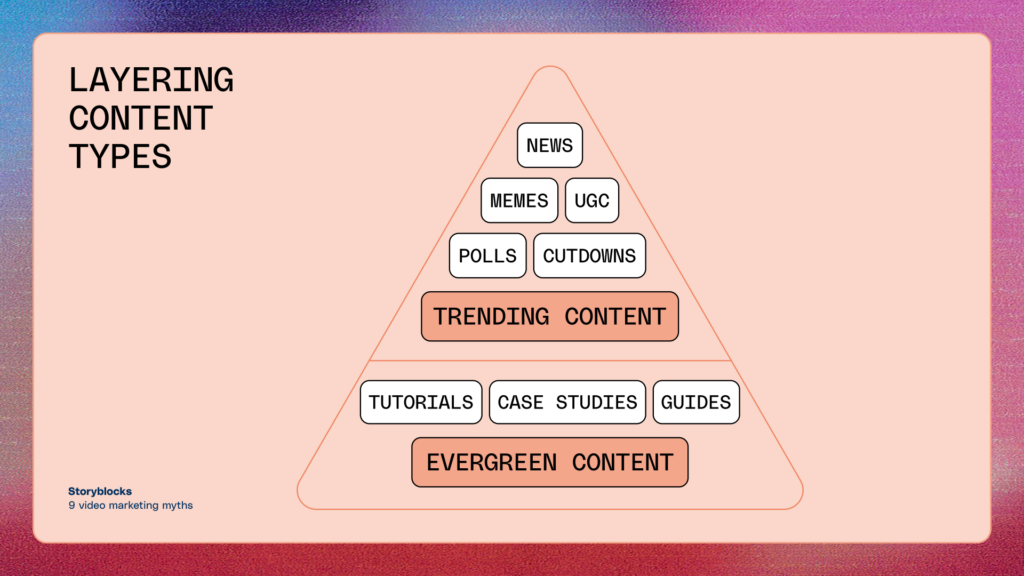
While trends come and go, evergreen content keeps paying off. Content that’s relevant today and a year from now acts like a compounding investment.
“The future challenge will be helping people filter through the noise to get to the good content,” Darren says. “Platforms are saturated with low-quality content. The creators who focus on high-value, evergreen pieces will always stand out.”
The beauty of evergreen content is that you can repurpose and refresh it for new platforms and audiences. Build a foundation of timeless content and layer on trending content to keep things fresh.
2. Think small (but collaborate big)
For small teams, collaboration is how you scale without spending the big bucks. You don’t need to hire a full-time team of editors, motion designers, and sound engineers. Instead, partner with others who bring different skills to the table by working together on a project, trading services or forming creative alliances.
“Collaboration is one of the easiest ways to scale without burning out,” Isaac says. “Some of my best projects came from creative collaborations. We each contributed something unique, and the result was so much better than if I had done it alone.”
3. Build agility into your strategy
The key to future-proofing is staying flexible. Platform algorithms will change. What works today might flop tomorrow. The best teams are the ones that build iteration into their process and treat every piece of content as a learning opportunity.
Kyle Weber highlights the importance of knowing when to scale back: “There’s a tipping point where adding people to a project doesn’t add quality—just complexity. Too many voices dilute the idea. Keep things lean, stay open to experimentation, and refine as you go.”
How Storyblocks helps with modern video production
For small teams, speed and affordability often come at the cost of quality. But that’s not the case with Storyblocks’ library of stock footage, templates, and assets. With unlimited access to diverse, professionally shot content, creators can fill in the gaps, speed up production, and maintain a polished, cohesive look—without blowing their budget.
“We regularly use stock at Superside to create high-quality output that doesn’t feel compromised. Modern stock libraries are helping small teams do big things without sacrificing quality,” says Kirsten.
With Storyblocks, you’ll save time, see faster turnarounds, lower costs, and create videos that look like a million bucks—without costing it.
Write your own rules
Popular video production myths are limiting. They flatten what could be a creative, exciting journey into rigid do’s and don’ts. The real secret to success? Build your own playbook.
Your unique experience, perspective, and voice are your greatest assets. Lean into them. The goal isn’t to copy what worked for someone else—it’s to create content that feels right for you, your organization, and your audience.